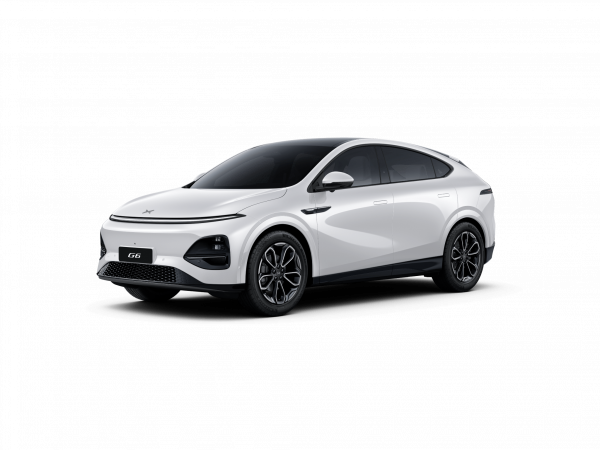
The XPENG G6 suits drivers who want family-SUV space without giving up fast EV charging. The current Australian New G6 offers up to 525 km WLTP range, an 80.8 kWh LFP battery in Long Range and Performance versions, and DC charging at up to 451 kW. A 10–80% charge is rated at 12 minutes under suitable conditions, while the 571 L boot expands to 1,374 L with the rear seats folded. Five seats, a 2.89 m wheelbase, 6 kW V2L capability and a 2024 five-star ANCAP rating make it particularly relevant to commuters, families and frequent intercity drivers.
Daily suitability starts with energy use rather than maximum range. The Standard Range version uses a 68.5 kWh LFP battery and is rated at 480 km WLTP on 18-inch wheels or 470 km on 20-inch wheels, with official consumption of 16.6 and 16.9 kWh/100 km respectively.
A driver covering 60 km per weekday would travel about 300 km over five working days. On paper, that is roughly 62.5% of a 480 km WLTP rating, so home charging once or twice a week could cover a typical commute without treating charging as a daily task.
The Long Range model stretches that operating window further. Its 80.8 kWh LFP battery is rated at 525 km WLTP and 17.9 kWh/100 km, while rear-wheel drive produces 218 kW and 440 Nm; 0–100 km/h takes 6.7 seconds.
That extra range is more useful for motorway travel than for short urban trips. At a steady weekly distance of 400 km, 400 km represents about 76% of the published 525 km rating before allowing for weather, speed, elevation, cabin heating, air-conditioning or luggage.
WLTP should be treated as a standardized comparison figure, not a guaranteed road result. XPENG states that speed, outside temperature, passengers, load, climate use, terrain and vehicle condition can all change actual range.
Charging performance is where the G6 differs more sharply from many older EV designs. The current Long Range and AWD Performance versions support up to 451 kW DC charging, while Standard Range supports up to 382 kW; XPENG quotes 10–80% in 12 minutes for all three versions under appropriate conditions.
A 70-percentage-point battery increase in 12 minutes changes how long-distance stops can be planned, although the 451 kW figure is a peak rather than a rate maintained through the whole session. Charger output, battery temperature, starting state of charge and thermal management all affect the actual curve.
XPENG also states that the G6 uses a full-domain 800V silicon-carbide electrical platform and a 5C battery system. The company introduced the updated European G6 in 2025 with the same 12-minute 10–80% charging claim and up to 451 kW input, providing a useful reference for the hardware now offered in other markets.
For drivers who regularly stop at 150 kW or 250 kW public chargers, however, the car cannot pull 451 kW from hardware that cannot supply it. The benefit is largest where newer high-output CCS infrastructure is available, so local charger availability matters almost as much as the vehicle specification.
| Version | Battery | WLTP range | Peak DC rate | 0–100 km/h |
|---|---|---|---|---|
| Standard Range | 68.5 kWh LFP | 470–480 km | 382 kW | 6.94 s |
| RWD Long Range | 80.8 kWh LFP | 525 km | 451 kW | 6.7 s |
| AWD Performance | 80.8 kWh LFP | 510 km | 451 kW | 4.13 s |
The table also shows why the Long Range model may suit more households than the Performance version. Both use an 80.8 kWh battery and support 451 kW charging, but Long Range reaches 525 km WLTP versus 510 km for Performance, a difference of about 2.9%, while giving up the AWD model’s 4.13-second acceleration.
Performance still has a clear use case in wet conditions, steep terrain or for drivers who prefer all-wheel drive. Its two-motor system develops 358 kW and 660 Nm, yet the trade-off includes a higher 2,220 kg kerb weight compared with 2,115 kg for Long Range.
Weight also matters once passengers and luggage are added. XPENG lists payload at 470 kg for Performance and 475 kg for Long Range, so five adults averaging 80 kg would use 400 kg before bags, leaving only about 70–75 kg of listed payload capacity.
That makes passenger and cargo planning more relevant than the 571 L boot figure alone. The rear luggage area expands to 1,374 L with the second row folded, an increase of about 141% over the seats-up volume, which is useful for bicycles, flat-pack furniture or larger travel bags.
The cabin itself is sized more like a regular family SUV than a city crossover. The G6 is approximately 4.75 m long and 1.92 m wide, while its turning radius is listed at 5.8 m, so buyers using older parking garages should check bay width and ramp clearance before focusing on range.
That physical size supports a five-seat layout rather than a third row. Families needing six or seven seats should look elsewhere, because no amount of boot capacity replaces additional certified seating positions.
For households that fit within five seats, rear-seat usability is helped by the long wheelbase and flat EV floor layout. XPENG lists rear ISOFIX mounting points, seven airbags and climate-focused comfort equipment, while selected versions offer front seats with heating, ventilation and massage functions.
Safety data provides a stronger basis than equipment counts alone. ANCAP tested the G6 in 2024 and awarded five stars, with 88% for adult occupant protection, 86% for child occupant protection, 81% for vulnerable road-user protection and 80% for safety assist.
Euro NCAP’s 2024 assessment reported 88% adult protection, 85% child protection, 81% vulnerable-road-user protection and 75% safety assist. Its frontal-impact result was 14.0 out of 16 points, while lateral impact scored 14.7 out of 16.
The difference between ANCAP and Euro NCAP percentages should not be read as contradictory vehicle behavior, because the organizations use their own scoring protocols and market assessments. Both assessments were published in 2024 and both placed the G6 at the five-star level.
Driver-assistance hardware also extends beyond basic cruise control. Australian specifications list adaptive cruise control, lane centring, lane-change assistance, autonomous emergency braking, blind-spot detection, rear cross-traffic alert, driver monitoring and automated parking functions.
Assistance is not autonomous driving. XPENG states that the driver must remain aware of traffic and intervene when required, particularly in poor visibility, snow, wet roads, rough surfaces or complex motorway exits.
That distinction matters for someone choosing the G6 mainly for technology. The cabin uses a 10.25-inch driver display and a 15.6-inch central touchscreen, plus Apple CarPlay, Android Auto, voice control and over-the-air software updates.
A 15.6-inch display gives navigation and charging information plenty of space, but drivers who prefer physical climate buttons should test the interface before purchase. In a 2026 vehicle, software quality affects ordinary tasks almost as often as power or acceleration.
The G6 also supports V2L, letting the traction battery supply external electrical equipment. Current Australian specifications list up to 6 kW on relevant versions, enough on paper to support multiple low- and medium-power appliances while camping or working away from fixed mains power.
For perspective, a 1,000 W appliance running continuously for two hours consumes about 2 kWh. Against an 80.8 kWh battery, that represents roughly 2.5% of gross battery capacity before conversion losses, so occasional V2L use does not necessarily consume a large share of stored energy.
That flexibility makes the G6 a more practical elctric suv for owners who combine commuting with camping, photography, portable work equipment or weekend travel. It is less relevant to buyers who never need external power, so V2L should be treated as a use-case feature rather than a reason by itself to choose the car.
Energy cost then depends heavily on where charging happens. Using the official 17.9 kWh/100 km Long Range figure, 15,000 km of annual driving corresponds to about 2,685 kWh before charging losses; multiplying that figure by a household or public charging tariff gives a more useful ownership estimate than comparing fuel prices alone.
Public fast charging can cost substantially more per kWh than residential electricity in many markets, so a driver doing 80% of charging at home may have a very different annual cost from someone relying almost entirely on rapid chargers. The car stays the same; the charging pattern changes the arithmetic.
Tyres deserve similar attention because the 2,065–2,220 kg kerb-weight range is high compared with many combustion crossovers. Strong low-speed torque and frequent hard acceleration can increase tyre wear, especially on the 358 kW Performance model, so replacement cost belongs in a realistic multi-year budget.
The Standard Range version reduces weight to about 2,065 kg and posts the lowest official energy use at 16.6 kWh/100 km on 18-inch wheels. Switching to 20-inch wheels changes the published figure to 16.9 kWh/100 km and reduces WLTP range from 480 to 470 km, about a 2.1% decrease.
Wheel choice therefore affects more than appearance. Smaller wheels may suit drivers prioritizing efficiency, tyre cost and ride comfort, while 20-inch wheels may appeal more to buyers who place greater weight on styling and steering response.
For motorway users, the Long Range specification remains easier to justify because 525 km WLTP gives more buffer between charging stops. XPENG also states that internal testing produced up to 427 km of added charge in 15 minutes for the Long Range model, although real public-charging sessions will vary.
A buyer who drives only 8,000 km per year around town may never use that capability often enough to justify choosing the larger battery. Someone covering 25,000 km per year with frequent intercity trips could use the same hardware every week, making charging speed much more relevant.
The final fit therefore depends on measurable habits: five-seat needs, annual mileage, parking dimensions, access to home charging, local high-power CCS coverage and typical passenger load. For a household that regularly uses 300–500 km travel days, the combination of 525 km WLTP range and a 12-minute advertised 10–80% session is far more useful than the 4.13-second sprint of the AWD model.
For shorter routines, Standard Range already provides up to 480 km WLTP, 382 kW peak charging and the same 571 L luggage capacity. Choosing the smaller battery can make more sense when most weeks use well under 50% of its available rated range, while Long Range better suits drivers who regularly cross regional or interstate distances.