A 2.12% Difficulty Cut and Three Pallet Sizes
The next difficulty estimate read −2.12% on 21 Sept 2026, which for a 79 TH/s batch is the difference between 0.00003544 and 0.00003621 BTC a day. In dollars that is $3.00 becoming $3.07, and for a 790 TH/s row it is $30.01 becoming $30.66. A batch order placed this month will live through dozens of these adjustments, so the first one is a calibration rather than an event.

Key takeaways
- A −2.12% difficulty estimate raises daily output by about 2.17%, not by 2.12%, because the change divides rather than multiplies.
- 79 TH/s goes from 0.00003544 to 0.00003621 BTC a day, a gain of $0.06 at $84,692.
- 790 TH/s gains $0.65 a day from the same adjustment, which is still small against a batch's capital cost.
- An estimate is not a confirmed change until the 2,016-block window closes and the new difficulty takes effect.
What a difficulty estimate is, and is not
Difficulty is recalculated every 2,016 blocks, which is roughly two weeks. The estimate published during that window is a projection from block times so far: if blocks are arriving faster than ten minutes on average, difficulty rises; if slower, it falls. The figure read on 21 Sept 2026 pointed to a 2.12% reduction, subject to how the remaining blocks in the window arrived.
For a buyer sizing a batch, the estimate is a useful stress test rather than a forecast. It says which way the next adjustment leans and by how much, and it lets you ask what a batch earns if the lean goes the other way. It says nothing about the following adjustment, or the coin price, or the fees inside blocks.
One more piece of context before the arithmetic: the estimate is produced from block times inside a window that has not closed, so it drifts as the window fills. A projection of −2.12% at the halfway point is not the same claim as −2.12% at the end, and treating an early reading as a final number is how plans acquire a false precision.
There is also a mechanical detail that trips people up. A lower difficulty means each share is worth more, so daily income rises by the inverse of the change. A 2.12% cut multiplies output by 1 ÷ 0.9788, which is 1.02166, so the gain is 2.17% rather than 2.12%. At the scale of one batch the difference is cents, but the habit of dividing rather than multiplying is worth forming before the numbers get larger.
Where the 2.12% lands in a day
For a 79 TH/s batch the daily output before the adjustment is 0.00003544 BTC, which is $3.00 at $84,692. After the inverse adjustment it is 0.00003621 BTC, or $3.07. The gain is seven cents a day, about $2.10 across a 30-day month, per 79 TH/s. Nobody buys hardware for seven cents; the point is that even a favourable adjustment is small against the capital tied up.
That is the honest frame for batch planning. Difficulty moves in single-digit percentages every two weeks, and over a year the compounding can be several tens of percent in either direction. A batch decision made on a single estimate is a coin flip dressed as analysis. The estimate matters because it is the most recent data point, not because it predicts the year.
What does change the picture is the direction of the trend. In a period of rising difficulty, each adjustment shaves a little off every machine, and the older units at the back of the pallet reach their power-cost floor sooner. In a falling period, the opposite happens and even inefficient units get a temporary reprieve. A batch buyer should ask which regime they expect to be running in for most of the hardware's life, and should not assume the last two weeks repeat.
The cost side does not ease with difficulty
A batch credited through ViaBTC Mining Pool earns the same per terahash as a single machine, but it pays for power at a scale that turns small errors into large ones. The 790 TH/s row draws 15.8 kW at 20 joules per terahash, which is 379.2 kWh a day and $22.75 at $0.06. Its post-adjustment credit is $30.66 gross, or $29.43 after the listed 4%. The gap is $6.68 a day, and it has to absorb cooling, rent, labour and the capital tied up in the pallet.
None of those costs move when difficulty falls. A 2.12% easing adds about 65 cents a day to that batch and adds nothing to the power bill, which is why favourable adjustments feel better than they are: they improve the margin without improving the machine. The reverse is also true, and less pleasant.
For a buyer the practical conclusion is to size the batch against a power cost that includes cooling, not against the raw chip figure. A pallet that clears its bill at 20 joules will not clear it at 26, and the difference between those two numbers is usually a decision about where the hardware is installed rather than which hardware is bought.
Three pallet sizes at one rate
The rows below use the same per-terahash rate and the same inverse adjustment. The middle row is the awkward one: 316 TH/s is not a natural pallet size, but it is exactly four times the smallest row and a tenth of the largest, which makes the linearity easy to check.
| Batch | BTC per day now | BTC per day after | Gross USD after | Change per day |
|---|---|---|---|---|
| 79 TH/s | 0.00003544 | 0.00003621 | $3.07 | +$0.06 |
| 316 TH/s | 0.00014178 | 0.00014485 | $12.27 | +$0.26 |
| 790 TH/s | 0.00035440 | 0.00036208 | $30.66 | +$0.65 |
Two operational notes belong with the table. First, the gain arrives only when the new difficulty takes effect; until then the old rate applies. Second, if the batch is not yet installed, the gain is theoretical, and a pallet that sits in a warehouse for three weeks misses the adjustment entirely while still ageing. Delivery timing is part of the return calculation, not an administrative detail. A batch ordered to catch a favourable estimate and delivered after it has passed is a batch that paid for a projection.
Worked example
Take the 316 TH/s row and show every step, including the inversion that people skip.
- Each TH/s earns 450 ÷ 1,003,000,000 = 0.00000044865 BTC in a day.
- 316 TH/s: 316 × 0.00000044865 = 0.00014178 BTC.
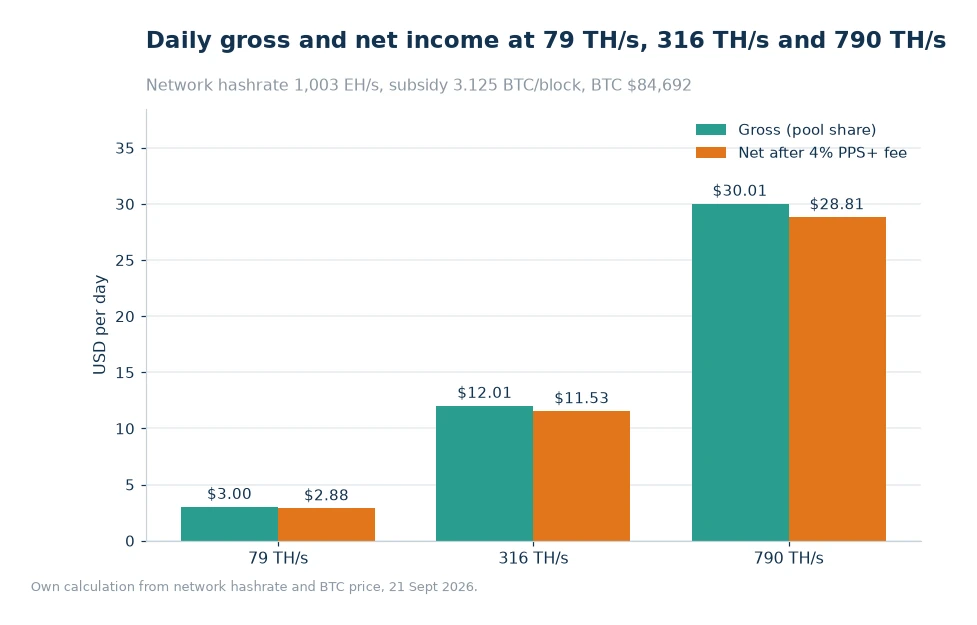
- Gross before: 0.00014178 × 84,692 = $12.01.
- Inverse of a 2.12% cut: 1 ÷ 0.9788 = 1.02166.
- Output after: 0.00014178 × 1.02166 = 0.00014485 BTC.
- Gross after: 0.00014485 × 84,692 = $12.27.
- Change: 12.27 − 12.01 = $0.26 a day, or $7.80 over 30 days.
- Applied instead as a simple 2.12% multiplication, the same row would read $12.26 — a one-cent error here, but a systematic one if it is repeated across every adjustment for a year.
Frequently asked questions
Is the 2.12% cut already in force?
No. It was an estimate read on 21 Sept 2026 during the adjustment window; the new difficulty only applies once the 2,016-block window closes, and the final figure can differ from the projection.
Why does a 2.12% cut raise income by 2.17%?
Because income is proportional to one divided by difficulty: 1 ÷ 0.9788 is 1.02166, a 2.17% increase, and the difference between the two percentages grows as the size of the adjustment grows.
Should a batch purchase wait for a falling difficulty?
Waiting is a bet that the next estimate moves in your favour and that hardware prices do not rise meanwhile; the honest approach is to test the batch against both directions and buy only if it survives the unfavourable one.
Re-run the sheet when the estimate flips
Keep a single-row calculation in the purchasing file: hashrate, per-terahash rate, current difficulty, and a column for a two percent move in each direction. When the estimate changes, update the input rather than rebuilding the model. The pool state page shows the network figures the calculation runs on, and the fee schedule fixes the deduction so only one number moves at a time. A batch that only works when difficulty falls is a bet, not a plan.
Sources: ViaBTC pool-state and pricing pages[1]. Snapshot 21 Sept 2026 — network 1,003 EH/s, difficulty 132.76 T, subsidy 3.125 BTC, 144 blocks a day, BTC $84,692, next adjustment −2.12%. Published 24 Oct 2026; the projection is arithmetic, not a forecast.